Thursday, February 27, 2020

Why Don't We Hear Antiwar Voices in America?

Image taken from Weldon Kennedy on flickr.com
Articles, news stories, or even blogs around antiwar are not easy to find. My professor showed our class two websites, ANTIWAR.COM and The American Conservative, both of which feature strong antiwar voices. Prior to this class, I had never even heard of the two websites. They are certainly not apart of mainstream media. After browsing the pages, I began to question why antiwar voices are not included in popular media. I came to one main conclusion; war is a large part of the American identity.

The United States military is an integral part of American culture. At every high school, college, and professional sporting event, the first thing to take place is the singing of the national anthem. At high profile events, such as the Super Bowl, a flyover often occurs. Why is this? I believe it is to showcase the power and strength of the United States military. It is a demonstration to the Americans, but also the rest of the world. With the military being so prominent in U.S. culture, many Americans see the military as a point of pride for our country.

I believe this is why we do not see many antiwar voices in mainstream culture or media. Speaking out against war is, in a way, speaking out against our military. This could be considered by many the un-American thing to do. It would not be viewed positively by a lot of readers. However, I do not think antiwar voices should be silenced. The Constitution grants citizens the First Amendment right to freedom of speech and freedom of the press. It is our job to ensure that all voices are heard, even if it is not a popular opinion.

If you would like to read some articles from individuals with antiwar voices, feel free to visit the websites linked above.

Wednesday, February 19, 2020

An Antitrust Investigation into Google

Image taken from Simon Steinberger 
The tech giant Google is being investigated for violating antitrust laws by attorneys general from 48 states, Washington, D.C., and Puerto Rico. Prior to hearing of the antitrust investigation into Google in an article by CBS News, I honestly had never heard of antitrust laws. Ironically, I turned to Google to learn a little more about what antitrust is, and why the laws are in place.

According to William Markham, a San Diego Attorney who has experience trying similar cases, antitrust laws "seek to promote competitive markets." The laws essentially are in place to avoid one company from monopolizing the market. So how is Google limiting competition? According to the CBS News article, investigators are looking to see if Google is dominating the "online advertising market and in internet searches."

I am not really surprised that Google is being investigated for dominating the advertising market. I am sure we have all experienced searching for something, and then within minutes, even seconds, an advertisement pops up for the same product. The idea of having advertisements tailored to what we 'want' to see has become a part of our lives. I never considered that this could be a form of dominating or monopolizing the market. However, it does make a lot of sense.

Lastly, I do not see an easy solution to this problem. If Google is found guilty of violating antitrust laws, I believe it will take a long time to solve the problem because Google is the most dominant search engine. Additionally, Steve Lohr of the New York Times claims antitrust investigations "can take years." It looks like we will not have a solution to this investigation for a long time. However, this probe into Google can serve as a reminder for consumers to look beyond the first things that pop up in a search.

Friday, February 7, 2020

The United States Supreme Court: The Importance of Marbury v. Madison

Image taken from Tim Sackton on Flickr
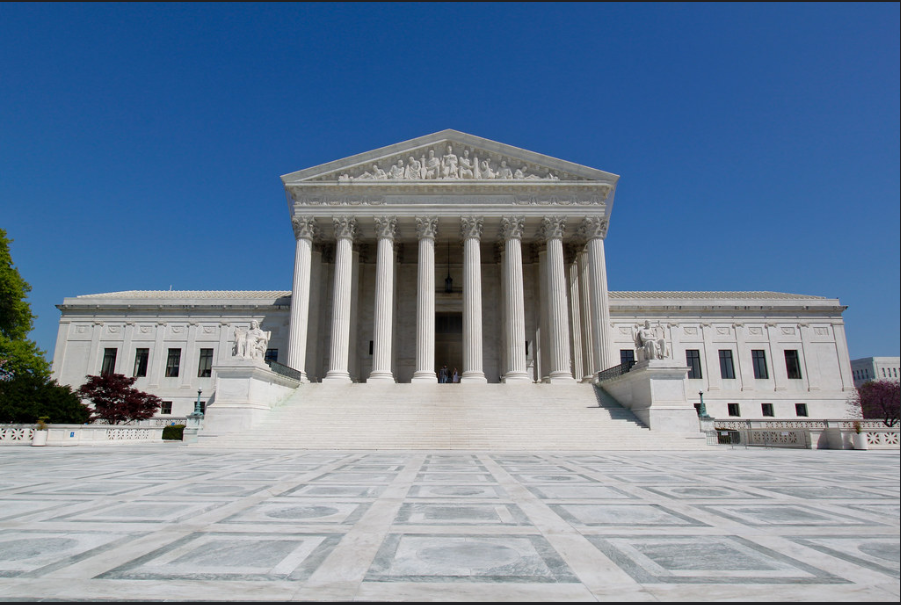
The United States Supreme Court was established in Article III of the Constitution. However, it officially was founded with the passing of The Judiciary Act of 1789 that was signed by President George Washington. According to History, the Supreme Court originally had six justices, with John Jay as the first chief justice. Today, the court has grown to include nine justices, and the current chief justice is John Roberts. While the Court has been around since 1789, the current Supreme Court would not have the extent of power it exercises today until the decision of the case Marbury v. Madison.

In the majority opinion, Cheif Justice John Marshall established judicial review. According to the Cornell Law School Legal Information Institute, judicial review is the principle "that the actions of the executive and legislative branches of government are subject to review and possible invalidation by the judiciary." Essentially, this means the United States Supreme Court has the ability to strike down an act of Congress or an act of the president as unconstitutional; thus, making the action illegal.

Under judicial review, three main standards of review may be used by the Supreme Court to determine the constitutionality of an action: strict scrutiny, intermediate scrutiny, and rational basis. Strict scrutiny is considered the "highest standard of review," and it is used in cases dealing with discrimination. Intermediate scrutiny is utilized when the government "passes a statute which negatively affects certain protected classes." Intermediate scrutiny is a relatively difficult standard to meet; however, it is easier than strict scrutiny. The final and the easiest standard to meet is the rational basis test, which is used when "no fundamental rights" are in question.

Clearly, the case of Marbury v. Madison has had major implications on the United States Supreme Court. Without this monumental case and the creation of judicial review, the Court would have nowhere near the amount of power it does today.

Thursday, January 30, 2020

Distrust of Facebook: An Election Year

Image taken from publicdomainpictures.net

It is no secret that 2020 is an important election year. With the Russian interference that occurred during the 2016 election, people are not only becoming more concerned with the type of political information posted on social media, but also worried about the sources of the information. 

Richard Nieva recently wrote an article discussing the concerns of citizens in Iowa ahead of the caucus next week. Nieva discussed the results of a small interview survey he conducted during his time in Iowa to determine which social media platform citizens were most concerned about. He talked to a variety of individuals who ranged in age and political affiliation. He found "Iowans singled out Facebook as the most untrustworthy" platform.

Image taken from Gage Skidmore
The distrust for sites like Facebook is reaching farther than the average citizen. Elizabeth Warren, a 2020 Democratic candidate, has also raised concerns about false information online. Carrie Mihalcik reported that Warren is proposing "civil and criminal penalties for knowingly spreading false information online about when and how to vote in US elections." Warren tweeted from her personal account, on January 29, 2020, calling out social media companies telling them "to take real steps" in fighting "disinformation spread on their platforms."

Do I think Facebook and other tech companies have a responsibility to stop false information from spreading? The simple answer is yes. However, I also believe that in today's world, individuals need to be smarter consumers. People need to become more media literate and evaluate the information more carefully. Ultimately, it is the choice of the consumer to decide what to trust and believe.

Our Relationship with Technology